The clock down here says 5:18. I should be sleeping, but here I am.
I tossed and turned for a good long while. I tried to go to one of several happy places - golfing among them - but it was of no use. Thoughts of work kept creeping back into my head.
Eventually (as you can tell) I just gave up. I figured if I get all this stuff down in an e-mail, I can get it the hell out of my head and perhaps enjoy what's left of the night. But it's going to take me a little while to wind down, so here I am.
But, as it stands, it looks like I'll be dozing through at least part of that Kent State-Akron game.
Saturday, September 22, 2007


Friday, September 21, 2007
Lost... and found
"I miss the blog. Enough said," Cheryl wrote in an e-mail a few weeks ago.
"It's been over a month... new post?" Tara e-mailed a few days ago.
So, here I am. I've been negligent, obviously, but for many reasons. All will sound like excuses so I won't bore you with the details. But I will say it involves a heavier-than-normal work schedule, a slew of addictive online games and a sick cat who refuses to want to get better. Feel free to draw your own conclusions.
I actually come here to inform you the set of links on the right has been slightly changed. The more astute of you will notice that Patrick Smith's column on Salon, Ask the Pilot, is no longer linked.
I freely admit I am no professional pilot. Though I have better knowledge than most about what it takes to fly a plane, my knowledge pales in comparison to real pilots. Hell, it pales in comparison to some of my friends at United Virtual. I recognize my limitations.
Mr. Smith is a pilot first; thus he is one of those folks with a lot more knowledge on flight than me. He's also a part-time journalist, writing that column for Salon. I'd like to think my journalistic knowledge would eclipse that of Mr. Smith, but apparently I'm wrong.
Seems lately the media can do no right for Mr. Smith. Two of the past three weeks, he's found it necessary to take a shit on the media - the mainstream media, of course, which seemingly can do no right for no one.
Two weeks ago, Mr. Smith wrote about the oft-replayed fire of a China Airlines jet burning after arriving at an Asian airport. The headline: "Lessons from a burning plane: What the media didn't tell you about a near disaster in Asia." We know where this is going.
Summing up Mr. Smith's complaints: An AP story generically referred to "the pilot" doing this or doing that, when in fact there are two crew members on the flight deck; the hype and overstatement of anchor comments as the replays aired on the networks (shocking! We've never seen that before); a CNN anchor mistakenly refers to the 737 as a big plane and the airline as "China Air." One of these is factually incorrect (the fourth); another, admittedly, could use more clarification (the first); the other two are merely opinion, one more agreeable than the other.
Calling a 737 a big plane isn't entirely accurate, but it's not entirely inaccurate, either. It's certainly no comparison to a 747 or a 777, but compared to a regional jet or personal aircraft, it's pretty big. At some point in the past - and I apologize for not being able to find a link - Mr. Smith even wrote that when you get down to it, the size of even a 737 is impressive; that idea, though, has largely been lost because of jetways and the air travel's loss of innocence in the public's mind.
I left a note for Mr. Smith, detailing some of these concerns. I told him I didn't think it was fair for me to comment on the CNN and TV critiques, since that's not really my area of expertise. Mr. Smith wrote back saying that wasn't fair, and apparently it's too much to ask to a reporter to get every single detail right. No, it's not, but if that's how he wants to read it, I don't believe I can change his perception. It's his column, and I'm happy to give him the final say, so I left it at that.
But it takes a little more to get me really pissed off. Two weeks later, and Mr. Smith writes about the latest media ball-dropping (though without such a suggestive headline this time). You'll find my beef at the end of page 1 (this great line: "While we're at it, let's hit the newspapers and clarify a few other distortions.") and on the top of page 2.
Mr. Smith mentions AP reporter Audra Ang, who reported on the Phuket crash of a One-Two-Go Airlines jet. In order, Mr. Smith takes issue with: a quote from the director general of the Thailand's Air Transport Authority; the validity of accounts from those on the plane; and a statement in the story that Smith admits is true.
So, in order:
Mr. Smith doesn't like the summation given by Chaisak Angsuwan, who claims the plane appeared to have "lost its balance and crashed." Mr. Smith says balance is no factor for flight, thus it's an incorrect statement. But I ask you, Mr. Smith, what was the reporter to do? Modify the quote to reveal its inaccuracy? Change the quote? Man, that would really give Salon the rest of the anti-MSM crusade something to howl about.
Leaving the quote out isn't much of an option; the guy's in charge of Thai airways. The buck stops with him. He's supposed to be an authority; clearly his statement calls his credibility into question. But that's not the reporter's problem. Our challenge is to tell you what happened and what people said about what happened; you, the reader, are smart enough to figure out if the guy's legit or full of shit.
The second verse, same as the first. If eyewitnesses and people on the plane told this to the reporter, how is she not to believe it? Again, do you misquote people because you don't believe the accuracy of their claims? Of course not. You quote them and let the reader decide.
Third verse: Mr. Smith admits this statement - "Many budget airlines use older planes that have been leased or purchased after years of use by other airlines." - is true, but still seems to have a problem with it. Does its inclusion leave the reader with a certain impression? Perhaps, but it's all about what you read into it. Mr. Smith says that older planes aren't necessarily less safe than newer ones; but he fails to mention they also need more care. Me, personally, I'd feel better about riding on a 1982 MD-80 from American - which I know has the personnel and engineering to keep these planes safe - than I would from a regional carrier in certain parts of the world.
I know, this has gone on way too long for most of you. But I'll end it with this: Mr. Smith is fortunate enough to be able to have a side job where he writes about a field he is an expert in; there can be no question of that. His columns run once a week; he can write on Monday or Wednesday or Thursday if he wants.
But his disconnect seems to come from the fact that general assignment news reporters aren't necessarily aviation experts. I'd also assert that deadline reporting is harder than it looks.
I challenge him to go cover any Red Sox game for the Boston Globe. Write an early feature, an early notebook, a standing notebook, a full-quote game story and an updated notebook. And to get everything accurate, to the T. No mistakes.
It's not as easy as you'd think.
"It's been over a month... new post?" Tara e-mailed a few days ago.
So, here I am. I've been negligent, obviously, but for many reasons. All will sound like excuses so I won't bore you with the details. But I will say it involves a heavier-than-normal work schedule, a slew of addictive online games and a sick cat who refuses to want to get better. Feel free to draw your own conclusions.
I actually come here to inform you the set of links on the right has been slightly changed. The more astute of you will notice that Patrick Smith's column on Salon, Ask the Pilot, is no longer linked.
I freely admit I am no professional pilot. Though I have better knowledge than most about what it takes to fly a plane, my knowledge pales in comparison to real pilots. Hell, it pales in comparison to some of my friends at United Virtual. I recognize my limitations.
Mr. Smith is a pilot first; thus he is one of those folks with a lot more knowledge on flight than me. He's also a part-time journalist, writing that column for Salon. I'd like to think my journalistic knowledge would eclipse that of Mr. Smith, but apparently I'm wrong.
Seems lately the media can do no right for Mr. Smith. Two of the past three weeks, he's found it necessary to take a shit on the media - the mainstream media, of course, which seemingly can do no right for no one.
Two weeks ago, Mr. Smith wrote about the oft-replayed fire of a China Airlines jet burning after arriving at an Asian airport. The headline: "Lessons from a burning plane: What the media didn't tell you about a near disaster in Asia." We know where this is going.
Summing up Mr. Smith's complaints: An AP story generically referred to "the pilot" doing this or doing that, when in fact there are two crew members on the flight deck; the hype and overstatement of anchor comments as the replays aired on the networks (shocking! We've never seen that before); a CNN anchor mistakenly refers to the 737 as a big plane and the airline as "China Air." One of these is factually incorrect (the fourth); another, admittedly, could use more clarification (the first); the other two are merely opinion, one more agreeable than the other.
Calling a 737 a big plane isn't entirely accurate, but it's not entirely inaccurate, either. It's certainly no comparison to a 747 or a 777, but compared to a regional jet or personal aircraft, it's pretty big. At some point in the past - and I apologize for not being able to find a link - Mr. Smith even wrote that when you get down to it, the size of even a 737 is impressive; that idea, though, has largely been lost because of jetways and the air travel's loss of innocence in the public's mind.
I left a note for Mr. Smith, detailing some of these concerns. I told him I didn't think it was fair for me to comment on the CNN and TV critiques, since that's not really my area of expertise. Mr. Smith wrote back saying that wasn't fair, and apparently it's too much to ask to a reporter to get every single detail right. No, it's not, but if that's how he wants to read it, I don't believe I can change his perception. It's his column, and I'm happy to give him the final say, so I left it at that.
But it takes a little more to get me really pissed off. Two weeks later, and Mr. Smith writes about the latest media ball-dropping (though without such a suggestive headline this time). You'll find my beef at the end of page 1 (this great line: "While we're at it, let's hit the newspapers and clarify a few other distortions.") and on the top of page 2.
Mr. Smith mentions AP reporter Audra Ang, who reported on the Phuket crash of a One-Two-Go Airlines jet. In order, Mr. Smith takes issue with: a quote from the director general of the Thailand's Air Transport Authority; the validity of accounts from those on the plane; and a statement in the story that Smith admits is true.
So, in order:
Mr. Smith doesn't like the summation given by Chaisak Angsuwan, who claims the plane appeared to have "lost its balance and crashed." Mr. Smith says balance is no factor for flight, thus it's an incorrect statement. But I ask you, Mr. Smith, what was the reporter to do? Modify the quote to reveal its inaccuracy? Change the quote? Man, that would really give Salon the rest of the anti-MSM crusade something to howl about.
Leaving the quote out isn't much of an option; the guy's in charge of Thai airways. The buck stops with him. He's supposed to be an authority; clearly his statement calls his credibility into question. But that's not the reporter's problem. Our challenge is to tell you what happened and what people said about what happened; you, the reader, are smart enough to figure out if the guy's legit or full of shit.
The second verse, same as the first. If eyewitnesses and people on the plane told this to the reporter, how is she not to believe it? Again, do you misquote people because you don't believe the accuracy of their claims? Of course not. You quote them and let the reader decide.
Third verse: Mr. Smith admits this statement - "Many budget airlines use older planes that have been leased or purchased after years of use by other airlines." - is true, but still seems to have a problem with it. Does its inclusion leave the reader with a certain impression? Perhaps, but it's all about what you read into it. Mr. Smith says that older planes aren't necessarily less safe than newer ones; but he fails to mention they also need more care. Me, personally, I'd feel better about riding on a 1982 MD-80 from American - which I know has the personnel and engineering to keep these planes safe - than I would from a regional carrier in certain parts of the world.
I know, this has gone on way too long for most of you. But I'll end it with this: Mr. Smith is fortunate enough to be able to have a side job where he writes about a field he is an expert in; there can be no question of that. His columns run once a week; he can write on Monday or Wednesday or Thursday if he wants.
But his disconnect seems to come from the fact that general assignment news reporters aren't necessarily aviation experts. I'd also assert that deadline reporting is harder than it looks.
I challenge him to go cover any Red Sox game for the Boston Globe. Write an early feature, an early notebook, a standing notebook, a full-quote game story and an updated notebook. And to get everything accurate, to the T. No mistakes.
It's not as easy as you'd think.
Friday, August 03, 2007
Catastrophe comes home
 That red car belongs to my former co-worker, Garrett Ebling.
He is one of the scores of people injured in the 35W bridge collapse in Minneapolis on Wednesday. He lived, but he's critically injured and will undergo surgery on Friday at the Hennepin County Medical Center.
I know the moment when we found out. I sit right next to our managing editor's office. She was on the phone and I heard her let out a loud gasp. This isn't unusual; she's a very exuberant person who laughs loudly, too. But each time I hear a noise like that, I hope everything's OK.
This time it wasn't. Ten minutes later, she was explaining this to our sports editor, who sits right across from me. I didn't pretend to hide my concern and afterwards, I immediately set to e-mailing former colleagues to tell them the news.
Garrett worked with us in various capacities on the newsside. After his final assignment here, as editor of one of our weeklies, he took a job back in his native Minnesota. He was out in the country, I believe, but he got considerably closer to his beloved Twins and Vikings.
We're still not sure why he was on the bridge when he was - we can only guess he was headed to see the Twins - but it's a miracle that he lived. Hell, when you think about it, it's a miracle that so many people survived.
That picture is haunting in some ways, affirming in others.
It's haunting to know that that car carried someone I call a friend. It's haunting to see it framed by such unwieldy, twisted metal. It's haunting to know that someone I know is at the center of the biggest story in the country.
But it's life affirming too: That car is on the precipice of disaster. A few more feet forward, and the car's completely underwater and maybe he becomes one of the casualties. I can't help but think were it not for the hand of God, I'd be a lot more sad than I am right now.
Get well, Garrett. We're all pulling for you.
Monday, July 23, 2007
Time to put this bad boy to use...
 I always wanted a guitar.
Now, as you can see, I have one - had it for some time, actually.
But I don't get to playing it much.
When I first bought it, I did; but it quickly dawned on me that I had spent my whole life as a drummer. There's a one-dimensional aspect when it comes to reading music for percussion: You see a note, you do your job. If you can keep a beat, you can play most any sort of percussion instrument (well, in a very basic sense, anyway). You play NOW and NOW and NOW and NOW, etc.
Turns out, there's a whole other dimension for virtually every other instrument. You do the same thing, but with the added challenge of playing NOW (B-sharp) and NOW (F) and NOW (C-flat) and NOW (A).
And that's pretty damn hard! At least for me, anyway. Plus all those notes tend to run together after a while, so I lose my place on the page pretty quickly. (Drum notes, particularly on a set, are far more predictable.)
So I've seen that there are a few computer programs out there that offer an interactive way to teach guitar, and I'm wondering if it's worth plunking down the money. I do feel bad that the thing just sits there most of the time; it's a beautiful guitar. (You can see it better here, though my body color is a little darker blue.)
Perhaps that would make a nice Christmas present too...
-- I WOOTED: Picked up a new remote control (pictured here) for us just after the last Woot-off.
Linds didn't seem too happy when I told her about it; well, I'd peg her mood at decidedly unimpressed. I have a feeling she will be, however, once we get it going. The thing has its own screen for heaven's sakes!
It was a refurbished deal, but I can live with that (unless it's just a piece of crap). Besides, the new ones cost between $250-$400. I paid $85, plus shipping.
Friday, July 13, 2007
25 ways to tell you're out west
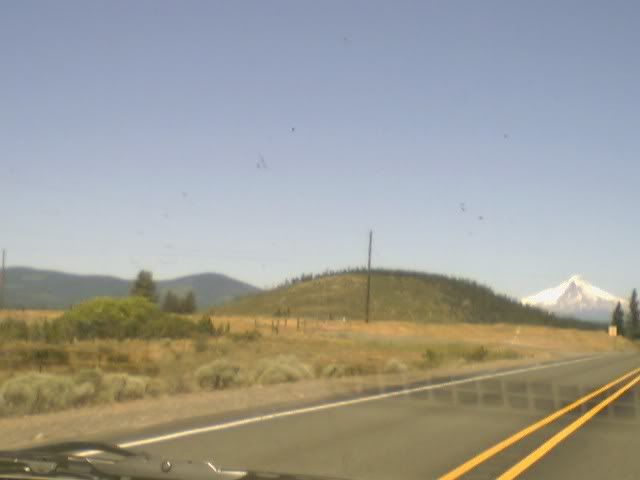 1. Dramatic topographical changes, like above. This pic was taken on the way to Portland; on the hill, you can see the trees come to a pretty abrupt end. There's a line there somewhere that delineates the forest from the high desert. This isn't like the east, as I can't really think of anywhere within a five-hour drive that would be vastly different than what's it like here; and even if I could, the change wouldn't be nearly as dramatic.
2. The desert. Even if it's the high desert.
3. Large trees. They make our forests look diminutive.
4. Large freaking mountains. In the photo, you can see Mt. Hood to the right. That whiteness isn't glare; it's snow. And this photo was taken on July 10. Are there any peaks in the east that even stretch past the treeline, let alone have year-round snow?
5. A long drive to get anywhere. It took us three hours to get from Bend to Portland - i.e., central Oregon to northwest Oregon. In that time from D.C., I could be in any one of seven states (Pennsylvania, New Jersey, Delaware, Maryland, West Virginia, Virginia and possibly North Carolina). Mark, my brother-in-law, suffered through a 10-hour drive to get home to Idaho; that would likely put us in Atlanta.
6. Les Schwab Tires.
7. Taco Time. (Though, rather inexplicably, there's one location east of the Mississippi: Altoona, Pa.
8. Laid-back attitudes, which do not equate in the northeast cities.
9. Resort towns, like Bend. It's hard to imagine even places like Killington fitting this sort of definition.
10. One of a hundred places in Bend to get a mocha.
11. The presence of buttes and foothills. (Here, they're called mountains.)
12. Volcanoes, which Mt. Bachelor was, Mt. Hood and Mt. St. Helens are.
13. Cities laid out in a logical manner. (We're looking at you, Boston.)
14. Hearing Portland, Seattle, San Francisco and Vancouver mentioned in the same way we talk about Baltimore, Philly and New York.
15. Hippies, which were in abundance in our trip to Powell's.
16. Sitting down to dinner and already knowing if the Phillies had won or lost.
17. Open ranges.
18. Cattle guards. (That story about the sheep is hilarious.)
19. Listening to the radio and hearing KQAK and KWLZ or watching TV and seeing KTVZ. It feels unnatural.
20. Realizing that Oregon became a state more than a century after my alma mater was founded.
21. Seeing a ranch.
22. How could I have forgotten this until now?! NO HUMIDITY. We went golfing one day when the temperature reached into the high 90s; it was hot, certainly, but not oppressive. And I didn't even feel sweaty! The sweat instantly evaporated in the dry air.
23. The chance to live waaaayyyy above sea level, which kicked my ass for most of the trip. Bend is about 3,500 feet above sea level; my in-laws' house a little more than 4,000. I'm happy to be able to walk up and down steps and not be out of breath anymore (while also admitting I'm grossly out of shape).
24. Driving on I-5. My normal commute takes me on the complete opposite, I-95.
And, lastly...
25. The big sky. I played softball just down from the Washington Monument, and I took the time to look: The sky really does seem bigger out west, though I have a feeling that is due in part to the vastness of the landscape. It's hard to see beyond a few miles anywhere in the east; when we took the photo above, we were still a good 30 miles (if not more) from Mt. Hood.
Subscribe to:
Posts (Atom)

